



TABLE OF CONTENTS
Key Takeaways
- If your water stays cloudy after proper chemistry + cleaning, your filter may be the bottleneck
- High filter pressure usually means “clean first,” but if it returns fast, replacement may be due
- Cartridge, sand, and D.E. filters all work—what changes is maintenance, cost, and filtration fineness
- Most replacement problems come from wrong sizing/compatibility or skipped safety steps
- A properly matched replacement can help restore filtration and circulation when a worn or damaged filter is contributing to poor performance.
Stop Guessing: Replace the Filter Before It Wrecks Your Flow
A pool filter doesn’t kill contaminants—it removes the debris and particles that can harbor them. Clear water starts with effective filtration.
 DID YOU KNOW?
Your pool filter is the bouncer at the club. If it’s tired, damaged, or overloaded, it can’t trap debris as effectively—and suddenly you’re dealing with cloudy water, pressure problems, weak returns, and nonstop “why does my pool hate me?” maintenance.
When a filter is worn out or overloaded:
-
- Water clarity may suffer
- Filtration performance can decline
- Circulation may be affected
- The system may require more frequent attention
Replacing worn or damaged filter media at the right time helps restore effective filtration and supports proper system operation.
This guide breaks down what to replace, when to replace it, how to choose the right replacement, and how to swap it safely—whether you run cartridge, sand, or D.E.
Replace vs. Clean: How to Know Which You Need
Before replacing a filter, it’s fair to ask: Can this just be cleaned?
Cleaning is usually enough when:
-
-
Pressure rises gradually
-
Flow improves after cleaning/backwashing
-
The filter media is intact and undamaged
-
Pressure rises gradually
Replacement may be needed when:
-
-
Cleaning no longer restores flow or pressure
-
The filter media is torn, cracked, flattened, or clumped
-
You’re cleaning far more often than normal
-
Water stays cloudy despite proper chemistry and maintenance
-
Cleaning no longer restores flow or pressure
Pool Filter Types 101
All pool filters do the same job—trap debris so your sanitizer can work on what’s left. The difference is how they trap it and how much work they demand from you.
Filter Type Comparison
| Feature | 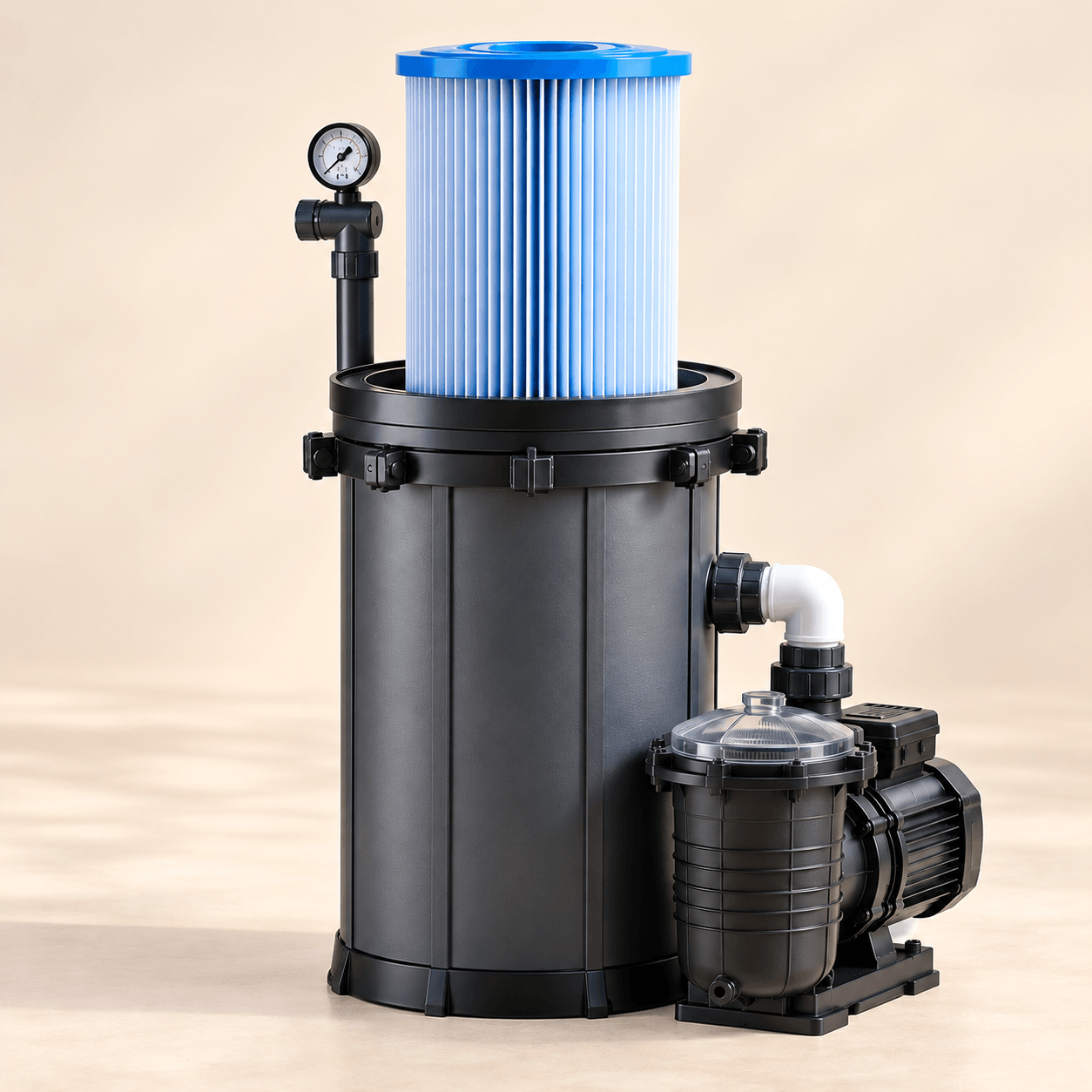 | 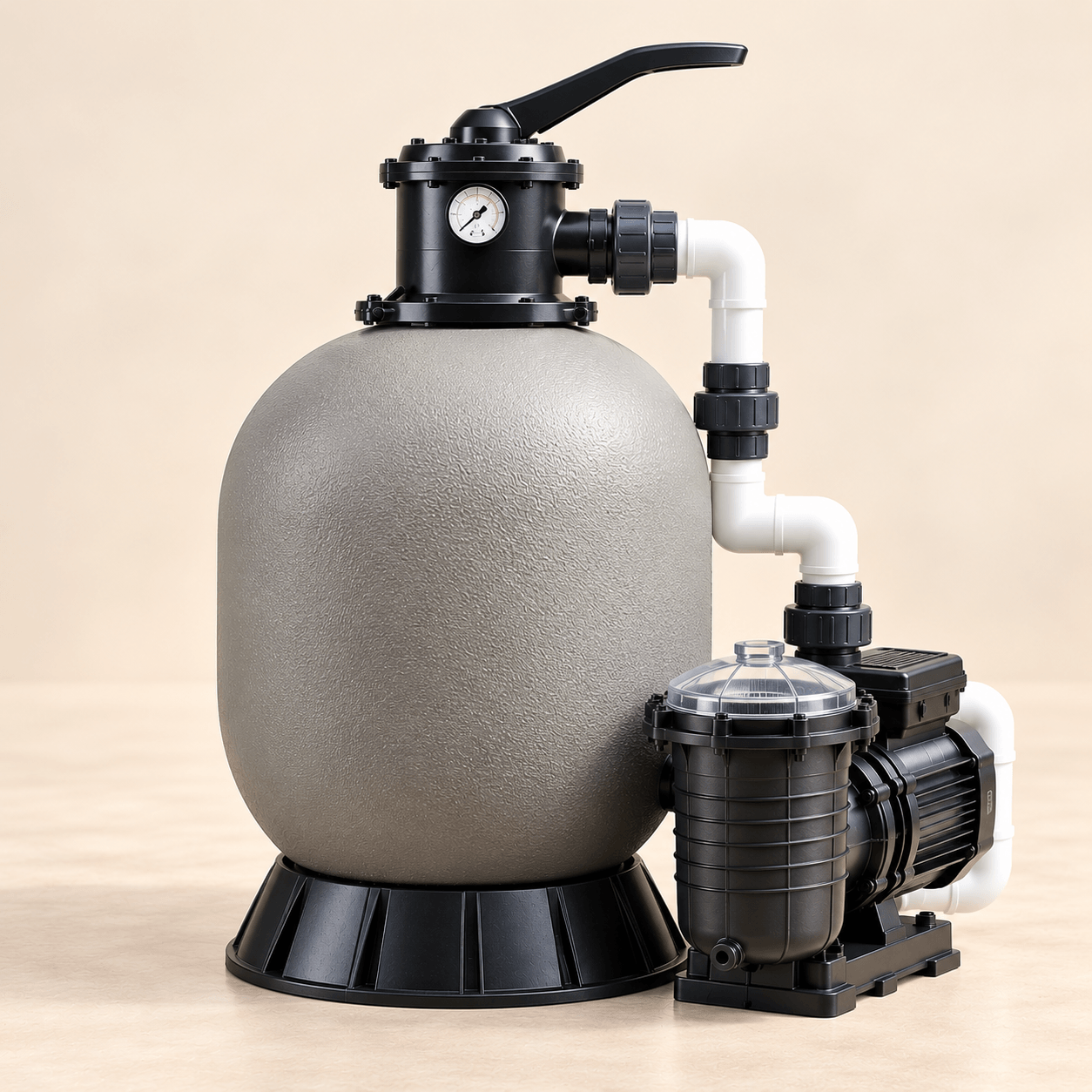 | 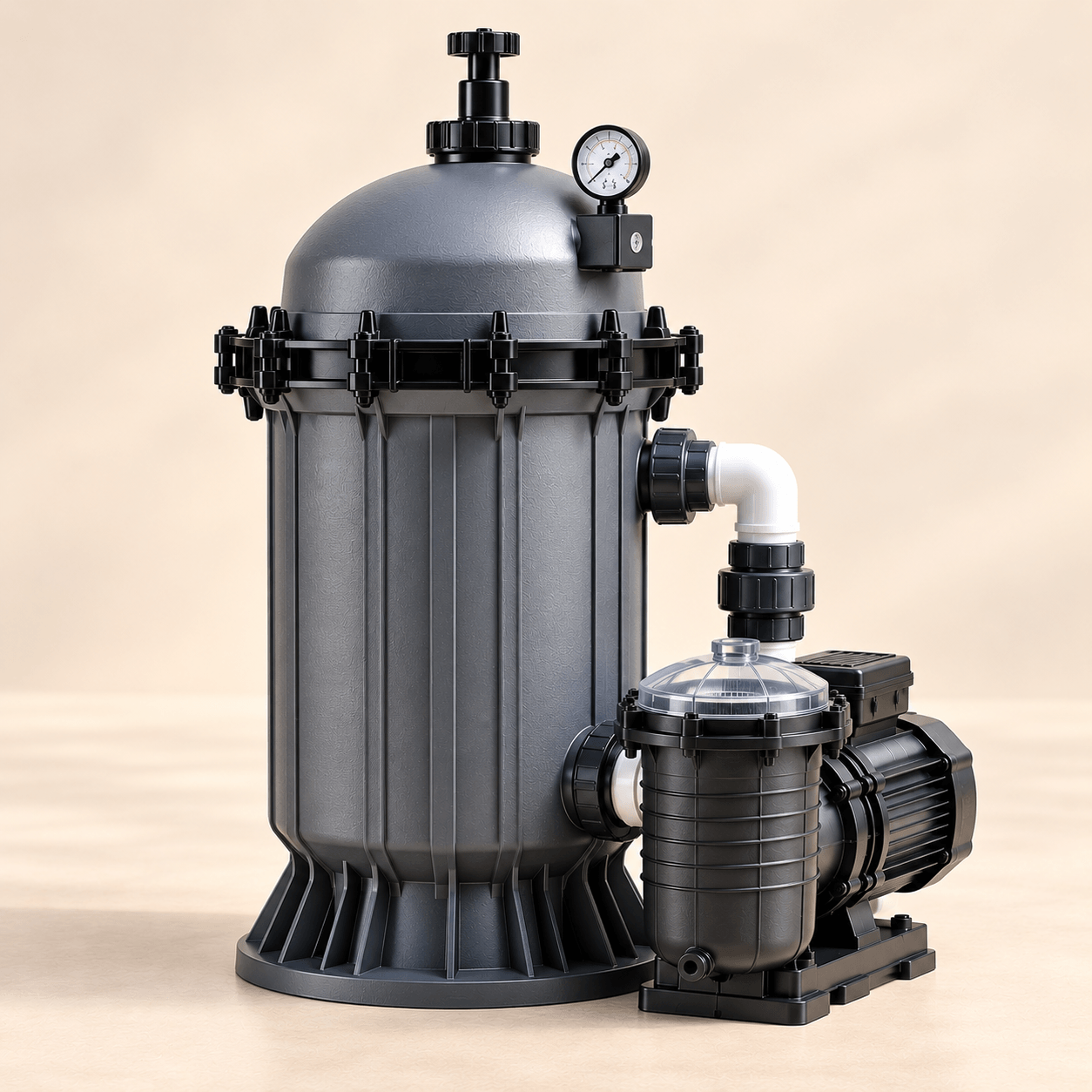 |
|---|---|---|---|
| Filtration / Clarity | Very good (great for fine debris) | Good (can improve with upgraded media) | Excellent (captures very fine particles) |
| Day-to-day maintenance | Rinse/clean periodically (no backwash) | Backwash on schedule | Most hands-on (clean grids + recharge D.E.) |
| Water usage | Low (no backwash water loss) | Higher (water lost during backwashing) | Moderate (water lost during cleaning/backwash) |
| What gets replaced | Cartridge element | Sand/media | Grids (and D.E. powder) |
| Typical replacement timing | Cartridge: 1–3 years* (varies by use/cleaning) | Media: 3–5 years* | Grids: 5–10 years* + D.E. refills as needed |
| Pros | Strong clarity • Easy upkeep • Water-saving | Durable • Simple operation | Very fine particle filtration |
| Best for | Owners who want easy maintenance + strong clarity | Owners who prefer straightforward routine maintenance | People who want maximum clarity and will maintain it |
*General estimate; varies by system/use/maintenance
Cartridge filters are popular for homeowners who want strong filtration without backwashing or water waste.
How to Tell What Filter You Have
Knowing your filter type is the first step to choosing the right replacement. If you’re not sure what’s installed, here are the quickest clues:
-
-
Cartridge filter: Usually a tall tank with a lid/band clamp; inside is a pleated cartridge (or multiple). Often no multiport valve (no BACKWASH/RINSE handle).
-
Sand filter: Round tank with a multiport valve labeled FILTER / BACKWASH / RINSE / WASTE / RECIRCULATE.
- D.E. filter: Tank can look like sand/cartridge, but inside are grids or “fingers.” Often has a multiport or push-pull valve, and you add D.E. media after cleaning/backwashing.
-
Cartridge filter: Usually a tall tank with a lid/band clamp; inside is a pleated cartridge (or multiple). Often no multiport valve (no BACKWASH/RINSE handle).

Warning
Not sure what you have? Use our Filter Finder tool to match your system to the correct replacement in minutes.
When to Replace Your Pool Filter
Not every problem means “replace.” A lot of issues are fixed by cleaning, chemistry, or clearing baskets. These are the signs that replacement is truly on the table.
1. Water stays cloudy even after cleaning + balanced chemistry
If your chemistry is in range, you’ve brushed, and filtration is running but water still looks dull/hazy—your filter may no longer be trapping fine debris effectively.
2. Pressure rises fast right after you clean it
A rising pressure reading often indicates increasing resistance through the filter. If pressure remains unusually high or climbs back quickly after proper cleaning or backwashing, inspect the media and check for other restrictions.
3. You’re cleaning constantly… and it’s not improving
If you’re rinsing cartridges nonstop or backwashing way more than usual, the filter may be losing capacity or the media may be compromised.
4. You see physical damage
-
-
Cartridge: torn pleats, collapsed core, end cap damage
-
Sand: channeling symptoms (water clarity suffers, pressure behaves oddly)
-
D.E.: torn grids, broken manifold, persistent D.E. returning to pool
-
Cartridge: torn pleats, collapsed core, end cap damage

5. Flow is weak even with a clean system
If baskets are clear and the filter is clean but flow still struggles, the filter may be restricting water due to internal damage or packed media.
Warning
How Often Should Pool Filters Be Replaced?
DID YOU KNOW?
Over-cleaning a cartridge can shorten its lifespan by damaging the pleats.
Replacement timing depends on:
-
- Pool size and usage
- Debris load
- Water balance
-
Cleaning frequency
These ranges assume normal residential use and decent maintenance.
-
-
Cartridge elements: often 1–3 years; shorter if heavy use, lots of debris, or poor chemistry
-
Sand media: often several years; inspect or replace when backwashing and normal maintenance no longer restore expected filtration performance, following manufacturer guidance
- D.E. grids: often 5–10 years; replace sooner if torn, brittle, or repeatedly clogged beyond cleaning
-
Cartridge elements: often 1–3 years; shorter if heavy use, lots of debris, or poor chemistry

Pro Tip
Age alone isn’t the trigger. Performance is. If your filter is old and showing the signs above, replacement usually pays for itself in time saved and chemicals not wasted.
How to Choose the Right Replacement
This is where most people mess up—buying something “close enough.” Filters are picky.
Compatibility (non-negotiable)
-
-
Match your filter model number (on the tank label)
-
For cartridges: match part number or exact dimensions
-
For sand/DE: follow the manufacturer’s required media type + amount
-
Match your filter model number (on the tank label)
Sizing (match the system, don’t downsize)
For cartridge filters, match the filtration area and dimensions specified for your housing. Surface area affects dirt-holding capacity and filtration performance, but a replacement still needs the correct dimensions, end-cap configuration, openings, and fit for the system.

Quality signals (simple and practical)
-
-
Cartridge: Sturdy, reinforced core, uniform pleats, clean end caps, consistent banding
-
Sand: Choose the correct grade; consider approved alternatives (like glass media) only if your manufacturer supports it
-
D.E.: Correct media type; use the amount specified by your filter manual
-
Cartridge: Sturdy, reinforced core, uniform pleats, clean end caps, consistent banding
Pro Tip
Using the wrong size or style filter can restrict flow and strain your pump.
How to Replace a Pool Filter (Step-by-Step)
This section is written for DIYers. Always follow your specific manufacturer manual if steps differ.
Before you start (for all filter types)
-
-
Turn off power to the pump and prevent any timer or automation controls from restarting it while you work
-
Open the air relief valve (if present)
-
Confirm the system is depressurized (pressure gauge at/near zero)
- Close valves if needed to prevent backflow
-
Turn off power to the pump and prevent any timer or automation controls from restarting it while you work
Warning
Tools You’ll Need
-
- Replacement filter or media
- Filter wrench (if required)
- Hose or bucket
- Towels
-
Silicone-based O-ring lubricant (optional)
Cartridge Filter Replacement
-
-
Turn off power and relieve pressure
-
Open the tank (band clamp or lid)
-
Remove cartridge(s) and inspect the inside of the tank
-
Rinse out debris from the tank bottom
-
Insert new cartridge(s), seated correctly
-
Lubricate the tank O-ring lightly with silicone pool lube (if recommended)
-
Reassemble and secure clamp/lid evenly
-
Restart the system according to the manufacturer's startup procedure and release trapped air as directed.
- Check for leaks and record “clean starting pressure”
-
Turn off power and relieve pressure
Pro Tip Record the clean starting PSI. Follow your filter manufacturer’s recommended pressure increase for cleaning. Many systems use a rise of roughly 8–10 PSI above the clean baseline as a general reference.
Sand Filter Media Replacement (Sand or Approved Alternative)
-
-
Turn off power and relieve pressure
-
Set multiport to CLOSED (if applicable or per your valve instructions)
-
Drain the tank using the drain plug/port
-
Open the filter (valve or top dome)
-
Carefully remove old sand/media (shop vac helps)
-
Inspect laterals and standpipe for cracks
-
Add water to cover laterals before adding new media (prevents damage)
-
Add new sand/media to the manufacturer’s specified amount
-
Reassemble
-
Run RINSE then FILTER (per your valve instructions)
-
Turn off power and relieve pressure
Caution
D.E. Filter Grid/Media Replacement
-
-
Turn off power and relieve pressure
-
Drain tank and open it
-
Remove grid assembly
-
Hose clean and inspect grids + manifold
-
Replace torn/brittle grids or cracked components
-
Reassemble tank and restart
-
Recharge with the correct amount of D.E. per manufacturer instructions (often through the skimmer)
-
Restart according to the manufacturer’s procedure and release trapped air as directed
-
Monitor returns—if you see D.E. coming back into the pool, stop and re-check assembly
-
Turn off power and relieve pressure
Warning
After Replacement: “Did I Do This Right?”
Maintenance Tips to Make Your New Filter Last Longer
-
-
Keep water level mid-skimmer or higher (avoids air + circulation issues)
-
Clean skimmer and pump baskets weekly
-
Keep chemistry balanced (bad chemistry wrecks filters faster than debris does)
-
Monitor pressure gauge weekly
-
Don’t run the system under constant high pressure—clean when pressure rises over baseline. Follow your filter manufacturer's recommended pressure increase for cleaning or backwashing. Many systems use a rise of roughly 8–10 PSI above the clean baseline as a general reference, but the specified threshold for your equipment should take priority.
-
Brush and skim regularly (less junk reaching the filter)
-
Keep water level mid-skimmer or higher (avoids air + circulation issues)
Pro Tip Good circulation makes everything easier: filtration, chemistry, and equipment life. Your filter can’t fix a pool that isn’t being circulated enough.
Need to re-order later?:
Filter Finder makes matching fast.
When to Call a Professional
Call a pool tech if:
-
-
The filter tank or clamp system is cracked/damaged
-
You can’t stop leaks after reseating O-rings/clamps
-
Pressure behaves erratically (spiking or dropping with no cause)
-
You suspect plumbing restrictions or underground suction/return issues
- A D.E. system returns media to the pool after proper assembly
-
The filter tank or clamp system is cracked/damaged


FAQs
How do I know if I should clean my filter or replace it?
What’s the most common sign it’s time to replace a filter?
How often should I replace a cartridge filter?
How often should sand be replaced in a sand filter?
How often should D.E. grids be replaced?
Will a clogged filter damage my pump?
What does “high filter pressure” actually mean?
Can the wrong filter size cause problems?
Do I need to replace the whole filter tank or just the media/element?
What should I do right after replacing a filter?
Was this post useful?


Questions/Comments
Have a question or thought? Click below to leave your comment.
Questions/Comments
Have a question or thought? Click below to leave your comment.