



TABLE OF CONTENTS
Key Takeaways
- Low CYA leaves outdoor-pool chlorine vulnerable to rapid UV breakdown
- Test your CYA level before adding stabilizer because fast chlorine loss can have other causes
- Water loss and replacement are the most common reasons CYA levels drop
- Most outdoor chlorine pools maintain 30–50 ppm CYA, while saltwater recommendations vary
- Raise CYA gradually because excess stabilizer is much harder to remove
Why Low CYA Makes Pool Chlorine Disappear
You add chlorine, give the pool time to circulate, and confirm that the level is back where it belongs. But after another sunny day, the chlorine reading has already fallen again. Without enough CYA, sunlight can break down chlorine surprisingly fast—even when your chlorine tested fine earlier in the day.
 DID YOU KNOW?
When an outdoor pool repeatedly loses chlorine, low cyanuric acid may be the reason. Cyanuric acid, or CYA, protects chlorine from being broken down too quickly by the sun. It’s often referred to as a stabilizer because without enough CYA in the water, chlorine can disappear faster than it can keep the pool properly sanitized.
That doesn't mean every low chlorine reading is caused by low CYA. Algae, heavy swimmer use, debris, contamination, and other water-balance problems can also increase chlorine demand even when your CYA level is adequate. Testing both levels helps you determine the actual issue before you add a chemical needlessly.
Continue reading to learn what low CYA means, how to recognize it, and how to raise CYA in a pool safely. We’ll also cover the testing and maintenance habits that help protect your chlorine without overcorrecting your water chemistry.
What Is Cyanuric Acid (CYA) in a Pool?
CYA helps protect chlorine from the sun's UV rays by temporarily binding to a portion of it, slowing how quickly chlorine breaks down in outdoor pools.
A simple way to think about CYA is that it acts like sunscreen for your chlorine.

Without that protection, direct sunlight can break down free chlorine rapidly. With the right amount of CYA, chlorine has more time to sanitize the water before UV exposure destroys it. Too much CYA can reduce chlorine's effectiveness if free chlorine isn't maintained appropriately.
Because CYA and free chlorine work closely together in pool chemistry, always check both when either or both levels are out of range.

Fun Fact
Indoor pools typically need little or no CYA because chlorine isn't exposed to the same direct UV sunlight as it is outdoors.
Test Before You Add Stabilizer
Never raise CYA based on symptoms alone. CYA changes much more slowly than chlorine, and adding stabilizer without a current reading can create a long-term water-balance problem.
Test CYA at pool opening, about once a month during the swim season, and after events that can dilute or remove pool water, such as heavy rainfall, major water replacement, repeated backwashing, overflow, or a suspected leak. Check free chlorine at the same time so you can see whether the pool has both enough stabilizer and enough active sanitizer.
Test Strips
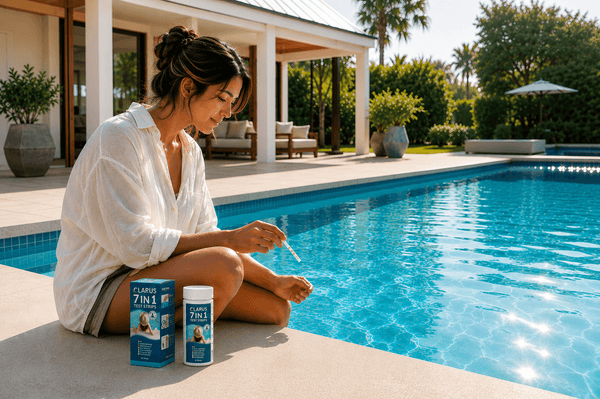
Multiparameter pool test strips can provide a quick estimate of your stabilizer level along with chlorine, pH, alkalinity, and other important readings. They are useful for routine checks and for spotting a CYA level that has moved outside its expected range.
When Using a Test Strip:
-
- Follow the strip instructions closely.
- Dip the strip for the correct amount of time.
- Hold the strip as directed.
- Compare the colors within the specified reading window.
- Avoid wet fingers, expired strips, improper storage, and delayed readings, as each can affect the result.
Liquid Test Kits
Most liquid CYA tests use a turbidity method. A reagent reacts with the CYA and clouds the water sample, which is then added to a viewing tube until the black dot at the bottom is no longer visible.
When Using a Liquid Pool Test Kit:
-
- Follow the kit instructions for the correct sample size, reagent amount, and mixing time.
- Collect the sample below the surface and away from returns, skimmers, and chemical feeders.
- Perform the test in bright, indirect light without wearing polarized sunglasses.
- Hold the viewing tube around waist level and look directly down into it.
- Add the sample until the black dot disappears, then read the CYA level at the waterline.
Liquid pool test kits can measure a wide range of readings, including chlorine, bromine, pH, total alkalinity, calcium hardness, and CYA. Because not all kits include each test, make sure to choose one that specifically measures CYA.
Pool Store Water Testing
A pool store can provide a second CYA reading when a home test is unclear or outside its measurable range. It can also evaluate free chlorine, pH, total alkalinity, calcium hardness, and other readings that may be contributing to the same water problem.
When Collecting a Sample for Pool Store Testing:
-
- Use a clean container that has not held chemicals or household cleaners.
- Collect the sample below the surface.
- Stay away from returns, skimmers, and chemical feeders.
- Fill the container with enough water for a complete analysis.
-
Seal the container and have the water tested promptly.
Compare Your CYA and Free Chlorine Results
Before adding stabilizer, compare both your CYA and free chlorine readings. Together, they can help show whether chlorine lacks enough UV protection or whether another issue may be causing it to disappear.
| Pool Type | Recommended CYA | Recommended Free Chlorine |
|---|---|---|
| Outdoor chlorine pool | 30–50 ppm | 2–3 ppm |
| Outdoor saltwater pool | 60–80 ppm* | Follow manufacturer guidance |
*Saltwater CYA and free chlorine recommendations vary by system. Follow the ranges specified by the salt chlorine generator manufacturer.
If CYA is low but free chlorine is still within range, chlorine may begin dropping as the pool receives more sunlight throughout the day.
If both CYA and free chlorine are low, inadequate UV protection may already be contributing to the loss of available sanitizer.
If CYA is within range but free chlorine is low, look for another source of chlorine demand, such as algae, contamination, heavy pool use, or poor circulation before adding stabilizer.

Pro Tip
Test first, adjust gradually, and retest before adding more. CYA is much easier to raise than it is to lower.
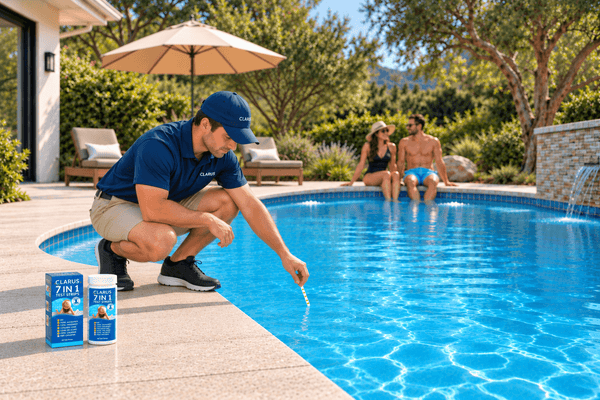
Clarus 7-in-1 Pool & Spa Water Quality Test Strips help you check stabilizer, chlorine, pH, alkalinity, and other important water levels before making an adjustment.Test Before You Treat
What Happens When CYA Is Too Low?
When CYA is too low, chlorine has very little protection from sunlight. An outdoor pool may test within range after a chlorine treatment and then lose much of that chlorine as the day goes on.
As the free chlorine level falls, the pool has less sanitizer available to control bacteria, algae, and organic contaminants. Low CYA does not directly create cloudy water or algae, but the resulting loss of chlorine can leave the pool vulnerable to both.
Low CYA can lead to:
-
- Chlorine levels that fall quickly during the day
- More frequent chlorine additions
- Increased chlorine use and potentially higher chemical costs
- Difficulty maintaining a free chlorine reading
- Cloudy or dull-looking water
- Recurring algae growth
- Inconsistent water quality
These problems often look like a chlorine issue because chlorine is the reading that keeps disappearing. The underlying problem, however, may be that there is not enough CYA to protect it.
Signs Your Pool’s CYA Level May Be Too Low
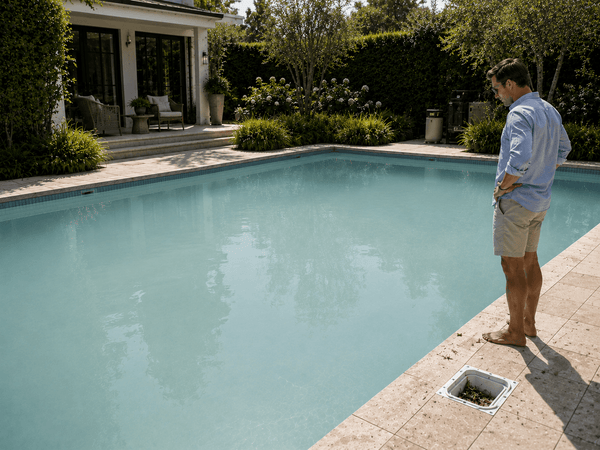
Low CYA usually reveals itself through a pattern rather than one visible change in the water. The strongest clue is often chlorine that holds after treatment but drops again following several hours of direct sunlight.
For example, you shock the pool on Saturday evening. Sunday morning, the chlorine tests perfectly. By Sunday afternoon, it is almost gone even though the water still looks clean. That pattern can be a sign that low CYA is allowing sunlight to break down chlorine too quickly.
Common signs include:
-
- Free chlorine drops noticeably every sunny day
- You need to add chlorine more often than usual
- The pool struggles to hold a chlorine reading
- Water turns cloudy again after treatment
- Algae returns even after chlorine is restored
- The pool receives long periods of intense sunlight
- A saltwater pool struggles to maintain its target chlorine level
- The pool was recently drained, refilled, backwashed, or diluted
None of these signs confirms low CYA by itself. Test the water before treating so you can separate a stabilizer shortage from algae, contamination, circulation problems, or another source of chlorine demand.
The comparison below helps narrow down the cause, but the next step should always be an actual CYA and chlorine test.
What Causes Low CYA in a Pool?
DID YOU KNOW?
Newly filled pools often contain little or no CYA because fresh water doesn't naturally contain stabilizer.
CYA usually drops when stabilized pool water is lost and replaced with fresh water. Unlike chlorine, CYA isn't rapidly consumed during normal sanitation. It usually decreases because water containing CYA leaves the pool through draining, backwashing, splash-out, leaks, or overflow. A newly filled pool may also have little or no CYA until stabilizer is added.
Understanding why CYA dropped can help keep it from happening again. Here are some common ways water loss and refilling can lower CYA levels.
Partial Draining and Refilling
Partially draining a pool removes some of its CYA. When that water is replaced with fresh water, the remaining stabilizer becomes diluted.
This is sometimes intentional when CYA is too high. If the pool was drained for repairs, winterization, water-balance correction, or another maintenance need, test CYA again after refilling.
Backwashing
Backwashing a sand or diatomaceous earth filter sends pool water out through the waste line. The replacement water added afterward contains little or no CYA, so repeated backwashing can gradually lower the stabilizer level.
One normal backwash may not cause a dramatic change. Frequent or extended backwashing can have a greater effect, especially in a smaller pool.
Splash-Out and Water Replacement
Swimming, water features, and active play can send stabilized pool water over the edge. Replacing that lost water gradually dilutes the CYA.
A small amount of splash-out is normal. Over a long swim season, however, repeated water loss and refilling can move the level downward.
Heavy Rainfall and Overflow
Rainwater contains no pool stabilizer. If heavy rain causes the pool to overflow or requires water to be drained, stabilized water leaves and is replaced by rainwater.
Rainfall does not simply wash CYA out of a sealed pool. The meaningful change occurs through dilution, overflow, or draining.
Leaks
A pool leak can steadily remove water containing CYA. Automatic refill systems may hide the water loss by replacing it continuously, allowing the stabilizer level to fall without an obvious drop in the waterline.
If CYA keeps declining without backwashing, draining, or unusual splash-out, check for other signs of a leak.
Using Unstabilized Chlorine
Liquid chlorine and cal-hypo add chlorine without adding CYA. Salt chlorine generators also produce chlorine without increasing the stabilizer level.
These sanitizers do not remove CYA from the water. However, they will not replenish stabilizer lost through draining, backwashing, splash-out, or overflow.
Trichlor tablets and dichlor granules are different because they add both chlorine and CYA. Regular use can help maintain or raise CYA, but it can also push the level too high over time, so use these products in moderation.
Myth vs Truth

Sunlight breaks down unprotected chlorine. CYA usually falls when stabilized water is removed or diluted.
Backwashing filters lowers CYA because pool water is sent to waste.
Dichlor and trichlor add CYA. Liquid chlorine, cal-hypo, and salt chlorine generators do not.

Sunlight burns CYA out of the pool.
The pool filter removes CYA.
Every chlorine product raises CYA.
Ideal CYA Levels

CYA and free chlorine work together, so one should never be adjusted without considering the other. Too little leaves chlorine vulnerable to UV exposure that causes it to break down more quickly.
The ranges below provide a general starting point. Always compare them with local requirements and the instructions for your pool equipment and sanitizing products.
Saltwater pools may benefit from a higher CYA level because the salt cell produces chlorine gradually throughout the day while the pump is running. Additional UV protection helps preserve that chlorine between production cycles and may reduce how hard the salt cell needs to work to maintain an adequate sanitizer level.
However, 60–80 ppm is not a universal requirement. Some salt chlorine generator manufacturers recommend a lower range, so check the system manual before raising CYA.

Caution
How to Raise CYA in a Pool
Once testing confirms low CYA, it can be raised with a standalone pool stabilizer or a stabilized chlorine product depending on whether chlorine is also low. Pool stabilizer contains CYA without chlorine, allowing the CYA level to be adjusted on its own. Dichlor and trichlor are products that contain both CYA and chlorine, raising CYA more gradually while adding chlorine at the same time.
Before choosing a method, confirm the pool volume and calculate the difference between the current CYA reading and the target. And always follow the product label because concentrations and dosing instructions can vary.
Method
Best Used For
Main Benefit
Main Limitation
Granular stabilizer
A measured CYA correction Concentrated and easy to calculate Dissolves slowly
Liquid stabilizer
A faster direct correction Disperses more quickly Usually costs more
Dichlor
Gradually raising CYA while chlorinating Adds chlorine and CYA together Continued use can overcorrect CYA
Trichlor
Ongoing tablet chlorination where appropriate Adds chlorine gradually CYA can accumulate and pH may fall
Stabilizers offer the most control over a confirmed shortage. Stabilized chlorine can work more gradually, but the CYA level must be monitored throughout its use.
Method 1: Add Pure CYA
Pure CYA is sold as granular or liquid pool stabilizer. Both raise CYA directly without adding chlorine.
Granular Pool Stabilizer
Granular stabilizer is concentrated and usually less expensive than liquid stabilizer, but it dissolves slowly, so product can settle onto pool surfaces if applied improperly. A common application method is placing the measured stabilizer in a sock so it can dissolve gradually without resting directly on pool surfaces.

Follow the steps on your product label to calculate how much granular stabilizer you’ll need and how to safely handle it.
For the sock method, follow these best practices to help granular stabilizer dissolve evenly without coming into direct contact with pool surfaces:
-
-
Use a clean, chemical-free sock made from a tightly woven material.
-
Measure the stabilizer before filling the sock, and divide larger doses between multiple socks when needed.
-
Tie the sock securely so no undissolved granules can escape into the pool.
-
Suspend the sock in front of a return without allowing it to rest against the wall, steps, or pool floor.
-
Keep the pump running to circulate water around the sock while the stabilizer dissolves.
-
Wear the protective equipment specified on the product label when handling stabilizer.
-
Keep swimmers away from the sock until the stabilizer has fully dissolved.
-
Allow the dissolved stabilizer to circulate before retesting the CYA level.
-
Allowing the stabilizer to dissolve gradually protects the pool surface and helps distribute it through the water. Once it has dispersed, test again before deciding whether another small adjustment is necessary.
Pro Tip
Aim slightly below the final CYA target with the first dose. You can add a little more after retesting, but removing excess stabilizer may require draining and replacing part of the pool water.
Some granular stabilizer labels permit adding the product slowly through the skimmer while the pump is operating. In this method, the undissolved stabilizer may remain in the filter while it dissolves.
Only use the skimmer method when the product label and equipment instructions specifically allow it. Avoid backwashing or cleaning the filter during the stated dissolution period because that can remove stabilizer before it enters the pool water.
Caution:
Liquid Pool Stabilizer

Liquid stabilizer is already dissolved or suspended, so it disperses faster and is easier to add. It is generally more expensive and still requires accurate pool-volume and dosage calculations.
Shake or mix the container if directed, add it at the location specified on the label, and keep the water circulating. Do not assume faster dispersion means another dose should be added immediately.

Pros
- Disperses faster than granular stabilizer
- Requires no sock or extended dissolving period
- No slow-dissolving granules to manage
- Easier to distribute throughout the water

Cons
- Usually costs more than granular stabilizer
- Still requires accurate pool-volume and dosage calculations
- May need to be shaken or mixed before use
- Can raise CYA too high if added too quickly
Method 2: Use Stabilized Chlorine
Dichlor and trichlor are stabilized chlorine products that add both chlorine and CYA to the water. They can be useful when both readings are low and need to increase together.
Because each dose raises both levels at once, stabilized chlorine offers less control than a standalone pool stabilizer. Continued use after CYA reaches its target can cause the level to climb too high, even when the pool still needs routine chlorination.
Dichlor vs. Trichlor
Dichlor and trichlor both add CYA, but they dissolve and dispense chlorine differently. The right option depends on how quickly the water needs to be treated and how the pool is designed to receive chlorine.
| Product | Common Form | How It Works | Main Consideration |
|---|---|---|---|
| Dichlor | Granules | Dissolves relatively quickly to raise chlorine and CYA | Repeated doses can raise CYA faster than expected |
| Trichlor | Tablets or sticks | Dissolves gradually through an approved feeder or floater | Continued use can increase CYA and lower pH over time |
Stabilized chlorine works best when both CYA and free chlorine are low. Testing throughout treatment helps prevent one level from reaching its target before the other.
-
-
Test CYA and free chlorine before choosing dichlor or trichlor.
-
Confirm the pool volume and calculate the dose carefully.
-
Use the product only through an application method approved by its label.
-
Monitor CYA, free chlorine, and pH throughout treatment.
-
Stop using stabilized chlorine once CYA reaches its target.
-
Switch to an unstabilized chlorine when the pool still needs chlorine but no longer needs CYA.
-
Stabilized chlorine may be convenient when both levels need attention, but it should not be used solely to raise CYA when free chlorine is already high.
Caution:
How Long Does It Take CYA to Increase?
Liquid stabilizer disperses relatively quickly, while granular CYA may take several days to dissolve completely depending on water temperature, circulation, and application method. The CYA reading may not reflect the full adjustment until the product has dissolved and moved throughout the pool.
Follow the retesting interval on the product label and test-kit instructions. When no more specific direction is provided, allow the pool to circulate and wait until the stabilizer has fully dissolved before testing again.
Retesting too soon may produce a reading that appears lower than the final result. Adding another full dose based on that early reading can push CYA above the intended target.
Common Mistakes When Raising CYA
CYA is easier to raise than it is to lower, so most stabilizer mistakes come from treating too aggressively. A careful first adjustment can prevent a much larger water-balancing problem later.
The safest approach is to calculate carefully, add conservatively, and confirm the result before making another adjustment.
Can CYA Be Too High?
Yes. Higher CYA protects chlorine from sunlight, but too much can reduce how much chlorine remains immediately available to sanitize and oxidize contaminants.
This is often called chlorine lock, but the term can be misleading. Chlorine does not suddenly stop working at one specific CYA level. Instead, it becomes less active as the amount of stabilizer increases.
High CYA can lead to:
-
- Reduced chlorine performance
- Cloudy or dull-looking water
- Recurring algae growth
- Difficulty maintaining proper sanitation
- A chlorine reading that does not provide the expected level of protection
- Partial draining and refilling to lower the CYA level
Because lowering CYA is more disruptive than raising it, stop adding pool stabilizer once the target range is reached.
How to Prevent Low CYA From Returning
Once CYA is back in range, monitor it as part of regular water testing. It will not fluctuate as quickly as chlorine or pH, but it should be checked after events that remove or replace a meaningful amount of pool water.
Test CYA again after:
-
- Partial draining or refilling
- Repeated or extended backwashing
- Heavy rain that causes overflow
- Major splash-out
- Suspected leaks
- Opening the pool for a new season
- Switching chlorine products
- Changing saltwater equipment or operating settings
Tracking these events makes a falling CYA level easier to explain. It also reduces the chance of adding stabilizer simply because chlorine dropped for another reason.
Keep Low CYA From Draining Your Chlorine

Low CYA can leave an outdoor pool’s chlorine exposed to sunlight, causing sanitizer levels to disappear faster than expected. Restoring the right amount of stabilizer helps chlorine remain available longer and makes the pool easier to maintain.
The solution begins with testing, not treatment. Confirm the CYA level, identify why it became low, calculate the adjustment carefully, and retest before adding more. Low CYA isn’t simply a chlorine problem—it’s a chlorine protection problem. Testing before treating helps you solve the real issue instead of chasing disappearing chlorine all season.
Related Articles
FAQs
What is cyanuric acid in a pool?
What happens if CYA is too low?
Can low CYA cause chlorine loss?
How long does it take stabilizer to work?
Can I swim after adding CYA?
Does pool shock raise CYA?
Does baking soda raise CYA?
Do saltwater pools need CYA?
Can too much stabilizer cause problems?
Was this post useful?


Questions/Comments
Have a question or thought? Click below to leave your comment.
Questions/Comments
Have a question or thought? Click below to leave your comment.