



TABLE OF CONTENTS
Key Takeaways
- Above-ground pools are affordable, fast to install, and great for first-time owners.
- Choosing the right size, material, and liner upfront prevents most long-term headaches.
- Clean water comes from three habits: circulation, cleaning, and balanced chemistry.
- Most water problems (cloudiness, algae, smells) come from skipped routines, not “bad water.”
- Safety matters: ladders, fencing, and supervision make the difference.
- The best pool is the one you can realistically maintain every week.
Above-Ground Pools 101: What to Know Before You Buy
Summer is synonymous with sunshine, vacations, and (obviously) swimming. If you want backyard pool life without the cost and construction of an in-ground pool, an above-ground pool is one of the easiest ways to make it happen.
 DID YOU KNOW?
Most “mystery pool problems” are just missed basics: low circulation, a dirty filter, or chemistry drifting out of range.
The difference between “sparkly pool season” and “why is it cloudy again?” usually comes down to three habits:
-
-
Circulation (run the pump long enough)
-
Cleaning (skim + brush + vacuum consistently)
- Chemistry (test regularly throughout the week, adjust in small steps)
-
Circulation (run the pump long enough)
This beginner guide breaks down the essentials: which pool type to choose, what to look for before you buy, how to set it up, how to maintain it, and how to keep it safe—so it stays fun, not frustrating.

Pro Tip
When something looks off, troubleshoot in this order: skimmer → pump → filter → returns → chemistry. It prevents panic-dosing and wasted weekends.
Why Choose an Above-Ground Pool?
Above-ground pools are popular for a reason. They deliver the pool lifestyle with maximum fun and minimal commitment.

Why above-ground pools are worth it
- Budget-friendly: far less expensive than in-ground pools
- Faster setup: many can be installed in a day (or a weekend)
- Flexible: easier to remove or relocate later (depending on the pool type)
- Options for every yard: multiple shapes, sizes, frames, and materials

What goes wrong when you rush the decision
- Buying the wrong size (doesn’t fit, or feels cramped)
- Installing on uneven ground (liner stress + structural issues)
- Underpowered pump/filter (cloudy water that won’t clear)
- Skipping safety planning (ladder + access issues)
How to Choose the Right Above-Ground Pool
This part is where smart decisions save you the most money (and headaches).
1) Pick the right location
Choose a spot that’s:
-
-
Level and well-drained (this is non-negotiable)
-
Free of rocks, roots, sharp debris
-
Away from trees (less leaves/pollen = less cleaning)
- Sunny if possible (helps water stay warmer)
-
Level and well-drained (this is non-negotiable)

Warning
2) Choose your size + shape
-
-
Round: space-efficient and usually easiest to install
-
Oval: more swim space than round while staying backyard-friendly
- Rectangular: best for actual swimming/playing, but usually needs more yard clearance
-
Round: space-efficient and usually easiest to install
Pro Tip
Measure the space twice and plan for at least 3 feet of clearance around the pool for walking, cleaning, and ladder access.
3) Pick the right frame/material
Most above-ground pools fall into these categories:
-
-
Steel: economical and durable, but can rust if scratched/damaged
-
Aluminum: lighter and rust-resistant
-
Resin: corrosion-resistant and low-maintenance
- Hybrid: combines materials for balanced strength, resistance, and cost
-
Steel: economical and durable, but can rust if scratched/damaged

4) Don’t cheap out on the liner
DID YOU KNOW?
Small liner punctures caused by debris beneath the pool can be surprisingly easy to overlook—and are one reason proper ground preparation matters so much.
Your liner is what holds everything together (literally). Look for:
-
-
UV resistance
-
Thicker vinyl
-
Strong seams
- The correct fit for your pool model
-
UV resistance
5) Pick depth based on your swimmers
Most above-ground pools are around 42”–54” deep. If you’ve got young kids or non-swimmers, choose accordingly.
Common Types of Above-Ground Pools
Here’s the quick breakdown so beginners don’t get lost in product pages:
-
-
Soft-sided pools: Budget-friendly, vinyl liner supported by a frame. Easiest setup. Great for smaller yards.
-
Metal frame pools: Sturdier than soft-sided, often galvanized steel walls + vinyl liner. Popular “middle ground.”
- Rigid wall pools: Most durable + best aesthetic. Aluminum/resin wall systems. Higher cost and more complex install.
-
Soft-sided pools: Budget-friendly, vinyl liner supported by a frame. Easiest setup. Great for smaller yards.


Myth vs. Truth
MYTH
Any above-ground pool is basically the same.
TRUTH
The wall/frame determines stability, lifespan, and maintenance.
If you want “set it and forget it” durability, rigid wall pools usually win, especially for families who plan to use the pool for years.
Step-by-Step: Setting Up Your Above-Ground Pool
Most kits come with detailed manufacturer instructions—follow those first. This is a beginner-friendly overview most first-time owners can expect.

Step 1: Select the location
-
-
Minimum 3 feet of clearance around the pool
-
Mark underground utilities before digging or leveling
-
Avoid trees if possible
-
Confirm the base is level
-
Minimum 3 feet of clearance around the pool
Step 2: Prep the ground
-
-
Remove rocks, roots, sharp debris
-
Use a ground cloth/pool pad for liner protection and comfort
-
Level the base carefully
-
Remove rocks, roots, sharp debris
Myth vs. Truth
MYTH
“Close enough” leveling is fine.
TRUTH
Even small slopes stress walls and liners. Leveling is the foundation.
Step 3: Assemble the structure
-
-
Follow the manual carefully
-
Have a second person help (some parts are bulky)
-
Follow the manual carefully
Step 4: Install the liner
-
-
Unfold slowly
-
Smooth wrinkles
-
Secure to top track properly
-
Unfold slowly
Step 5: Install pump + filter
This is what keeps the pool from turning into soup.
-
-
Confirm hose connections are tight
-
Check flow direction
-
Prime the pump if required
-
Make sure returns/skimmers flow correctly
-
Confirm hose connections are tight
Step 6: Fill the pool
-
-
Use a hose and fill slowly
- Monitor fill level (usually mid-skimmer range) as the water rises
-
Use a hose and fill slowly
Pro Tip
If the liner looks wrinkled during filling, stop and fix it early. Water weight locks wrinkles in fast.
Step 7: Test + balance water
Once full, test:
-
-
Sanitizer (chlorine/bromine)
-
pH
- Alkalinity
-
Sanitizer (chlorine/bromine)
Adjust one thing at a time and circulate before retesting.
Warning

Clarus 7-in-1 Pool & Spa Test Strips – Chlorine, Bromine, pH, Alkalinity, Hardness & Cyanuric Acid, 60 Count
Fast, reliable testing for routine pool care. Measures 7 key parameters in seconds to help keep your water balanced and consistent week after week.

Clarus 3-in-1 Pool & Spa Water Quality Test Kit – pH, Total Chlorine & Bromine
More precise testing when accuracy matters. Measures key levels with greater control, making it ideal for verifying results or diagnosing water issues.
Above-Ground Pool Maintenance Basics
Keeping an above-ground pool clear isn’t complicated—it just comes down to routine.

Your weekly “easy mode” routine
-
-
Skim surface debris (daily or every other day if you can)
-
Brush walls and waterline (weekly)
-
Vacuum floor (weekly or as needed)
-
Empty skimmer/pump baskets
-
Test sanitizer and pH regularly throughout the week, and adjust as needed
-
Run pump long enough for circulation
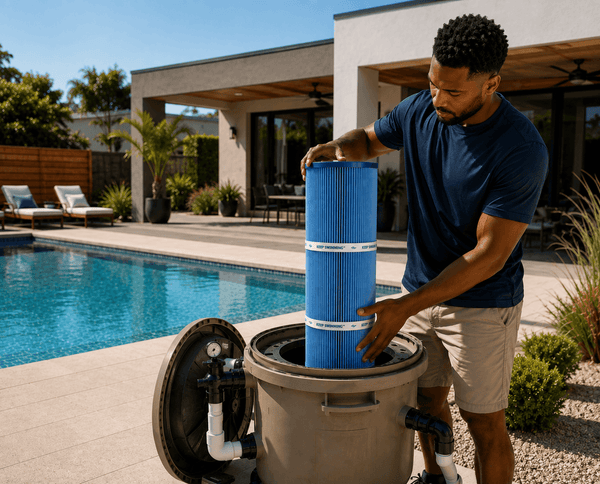
- Check filter pressure and clean as needed
-
Skim surface debris (daily or every other day if you can)
Pro Tip If water looks dull or hazy, increase run time and check filtration before adding more chemicals. Most “chemical problems” start as circulation problems.
How long should you run your pool pump?
During swim season, many above-ground pools may run around 8–12 hours per day as a practical starting point, but the right runtime depends on pool size, pump, filtration system, weather, water conditions, and manufacturer guidance.
Increase runtime during:
-
-
Heat waves
-
Heavy swimmer use
-
Storms/rain
-
Algae treatment
- Cloudy water episodes
-
Heat waves
If my chemicals test fine, I can run the pump less. Less circulation = less filtration. Run time still matters.
Myth vs. Truth
MYTH
TRUTH
Filter maintenance
-
-
Clean/rinse per manufacturer instructions
- Use your pressure gauge as your guide if you have one
-
Clean/rinse per manufacturer instructions
Pro Tip
Many filters may be ready for cleaning or backwashing when pressure rises around 8–10 PSI above the clean baseline, but always follow your filter manufacturer’s recommended threshold.
Cover when you’re not using it
A cover helps:
-
-
keep debris out
-
reduce evaporation
-
retain heat
- add a layer of safety (depending on cover type)
-
keep debris out
Winterization (if you freeze)
If your area freezes, follow your pool manual for closing procedures—especially with pump/filter protection.
Above-Ground Pool Safety Tips
Above-ground pools still require serious attention to water safety and controlled access.
DID YOU KNOW?
Entry and exit areas can create their own safety risks around an above-ground pool, making ladders, steps, decks, and controlled access important parts of the setup.
Minimum safety checklist:
-
-
Always supervise kids + non-swimmers closely
-
Follow all local barrier requirements, including fencing, self-closing/self-latching gates, or other required safeguards.
-
Prevent unsupervised access to ladders and steps when not in use
-
No diving (most above-ground pools aren’t deep enough)
-
Keep rescue gear nearby (life ring, reaching pole)
-
Keep a first-aid kit accessible
-
Learn CPR
-
Establish pool rules: no running, no diving, safe entry/exit
-
Always supervise kids + non-swimmers closely
Warning
Make Your Pool More Fun (Without Making It More Work)
A few upgrades that add joy without adding chaos:
-
-
Pool floats + toys (simple win)
-
Solar cover (warmer water + less evaporation)
-
Timer for your pump (consistency without thinking)
-
Lighting for evening swims
-
Decking (if you want easier access and a more “built-in” feel)
-
Pool floats + toys (simple win)
Troubleshooting Common Issues
Algae
What to do:
-
-
Brush affected areas
-
Test the water and determine the appropriate algae treatment
-
If shock is appropriate, follow the product label for dosing and circulation
-
Maintain adequate circulation and filtration during treatment
- Clean the filter as needed
-
Brush affected areas
Cloudy water
Usually caused by:
-
-
weak filtration
-
not enough pump run time
-
imbalanced chemistry
- low sanitizer
-
weak filtration
Fix order:
-
-
Increase circulation
-
Check/clean filter
-
Test + adjust chemistry
-
Retest after 24 hours
-
Increase circulation
Leaks
-
-
Check liner and hose connections
-
Patch small holes with a repair kit
-
For ongoing water loss, inspect fittings and plumbing
-
Check liner and hose connections
Pro Tip If water level drops below skimmer level, your pump can suck air which can damage the system. Fix leaks early.
Make It Fun, Not a Chore
Owning an above-ground pool should feel like a summer upgrade, not a weekly meltdown. Choose the right pool, set it up on a solid base, and stick to a simple routine (circulation + cleaning + chemistry). Do that, and you’ll spend way less time troubleshooting and way more time actually swimming.
Happy swimming!
Related Articles


Want pool tips that actually save you time?
Join the Clarus Newsletter for quick maintenance reminders, troubleshooting shortcuts, and seasonal checklists—delivered when it matters.
FAQs
How often should I test my above-ground pool water?
How long should I run my pump each day?
Do above-ground pools need a filter?
Why is my pool cloudy even if my test looks “normal”?
Do above-ground pools need the same chemicals as in-ground pools?
Do I need to shock my above-ground pool?
Should I use a pool cover?
Do I need a pump timer for an above-ground pool?
How often should I clean or replace my above-ground pool filter?
What size above-ground pool should I get for my backyard?
Was this post useful?


Questions/Comments
Have a question or thought? Click below to leave your comment.
Questions/Comments
Have a question or thought? Click below to leave your comment.